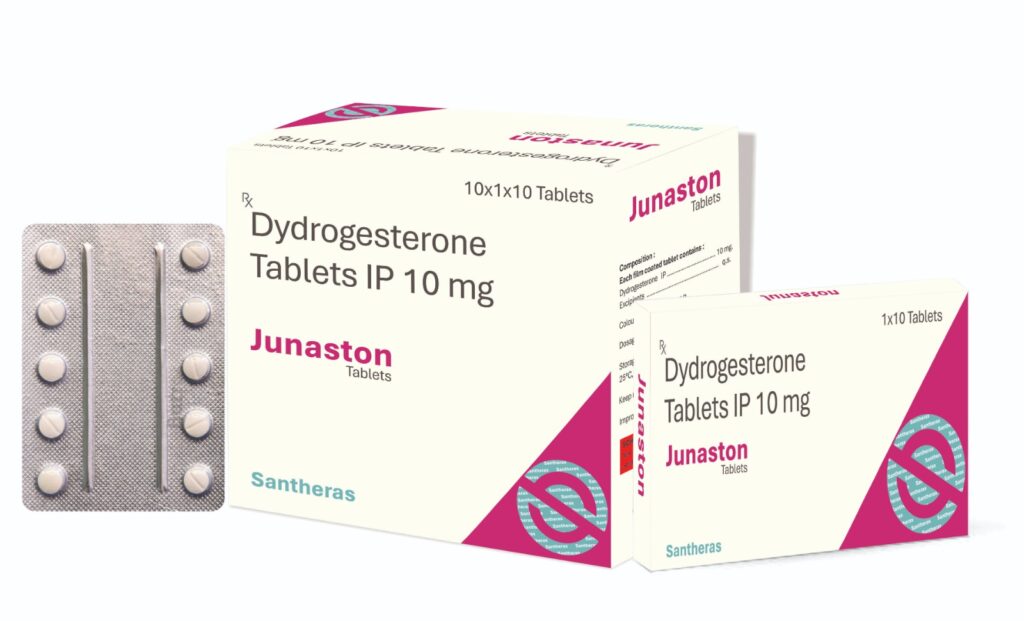
Junaston Dydrogesterone 10mg Tablets
| Dydrogesterone | 10 mg |
| Dosage Form | Oral Tablet |
| Drug Class | Progestogen |
| Route | Oral |
| Use Status | Prescription Only |
Recommended Dosage:
Take exactly as advised by the gynecologist or fertility specialist. Dose, start day, and duration vary by diagnosis and treatment cycle.
In Luteal Phase Defect:
Junaston may be prescribed after ovulation to support progesterone action during the luteal phase.
In Infertility Treatment:
Use may be aligned with ovulation induction, IUI, IVF, oocyte retrieval, or embryo transfer protocols as directed by the treating doctor.
In Recurrent Pregnancy Loss:
Use only after clinical evaluation. Do not stop suddenly during early pregnancy unless instructed by the physician.
General:
Swallow with water. If a dose is missed, ask the prescriber or pharmacist for advice rather than doubling the dose without guidance.
Pack Size
Junaston 10mg Tablets - Dydrogesterone 10mg. Pack details should be displayed as printed on the marketed pack.
Storage Instructions
Store in a cool, dry place away from direct sunlight and moisture. Keep the tablets in the original strip until use.
Keep out of reach of children. Do not use after the expiry date printed on the pack.
Prescription medicine. Use only under medical supervision, especially during fertility treatment or pregnancy.
Junaston 10mg Dydrogesterone Tablets
PRODUCT BENEFITS
- Contains Dydrogesterone 10mg – an oral progestogen for physician-guided progesterone support.
- Supports endometrial receptivity and secretory transformation in luteal phase defects.
- Useful in infertility care when luteal insufficiency is identified by a gynecologist or fertility specialist.
- May be used as luteal phase support after ovulation induction, IUI, IVF, or embryo transfer as prescribed.
- Relevant in recurrent pregnancy loss protocols where progesterone support is clinically indicated.
- Oral tablet format helps convenience and compliance compared with some non-oral progesterone regimens.
Conception & Fertility: Junaston 10mg Tablets
What is Junaston 10mg Tablet?
Junaston 10mg Tablet contains Dydrogesterone 10mg, an oral progestogen used on prescription where progesterone support is clinically required.
This content focuses on infertility due to luteal phase insufficiency, recurrent pregnancy loss, and luteal phase defects.
How does dydrogesterone support fertility care?
Dydrogesterone acts on progesterone receptors and helps prepare and maintain the endometrium, the uterine lining needed for implantation and early pregnancy support.
Because it is taken orally, it may be convenient for women who need luteal support under the supervision of a fertility specialist or gynecologist.
What is luteal phase defect?
The luteal phase is the post-ovulation part of the menstrual cycle, when progesterone helps convert the endometrium into a receptive lining.
A luteal phase defect refers to inadequate progesterone effect or a short/insufficient luteal phase, which may affect implantation or early pregnancy maintenance.
How may Junaston help in infertility due to luteal insufficiency?
In selected patients, dydrogesterone may be prescribed after ovulation, insemination, or embryo transfer to supplement luteal progesterone activity.
The goal is to support secretory endometrial transformation, implantation conditions, and early gestational support when the treating doctor identifies a need.
How is dydrogesterone relevant in recurrent pregnancy loss?
Recurrent pregnancy loss can have many causes, including genetic, anatomical, endocrine, immune, and unexplained factors. Progesterone support may be considered when luteal insufficiency or early pregnancy support is part of the clinical plan.
Junaston should be used only after medical evaluation and only for the dose and duration advised by the physician.
When should Junaston be taken?
The timing depends on the indication. In fertility treatment, progestogen support is commonly aligned with ovulation, insemination, oocyte retrieval, or embryo transfer protocols.
Do not self-start or stop Junaston during fertility treatment or pregnancy. Follow the exact prescription schedule.
Who should avoid self-medication?
- Women with unexplained vaginal bleeding.
- Patients with known allergy to dydrogesterone or tablet excipients.
- Patients with liver disease, hormone-sensitive conditions, or complex pregnancy history unless cleared by a doctor.
- Anyone taking other hormonal medicines without medical review.
What should patients remember?
Junaston 10mg is a prescription medicine. It is not a general fertility booster and should be used only for diagnosed progesterone-support needs.
Report severe abdominal pain, heavy bleeding, allergic symptoms, jaundice, or unusual symptoms to a healthcare professional promptly.
Is Junaston 10mg used for luteal phase support?
Yes, dydrogesterone may be prescribed for luteal phase support when a doctor wants to supplement progesterone activity after ovulation or assisted reproduction treatment.
The exact start day and duration should match the treatment plan, because natural cycles, IUI cycles, and IVF cycles may be managed differently.
Can Junaston improve endometrial receptivity?
Progesterone activity helps the estrogen-primed endometrium become secretory and receptive. Dydrogesterone is used to support this progesterone effect in selected patients.
Endometrial receptivity depends on several factors, so Junaston should be part of a complete fertility evaluation rather than a standalone solution.
Is Junaston useful after IUI?
Some clinicians prescribe luteal support after intrauterine insemination, especially when ovulation induction medicines are used or luteal insufficiency is suspected.
Patients should follow the dose and stop date given by their fertility specialist.
Is Junaston useful after IVF or embryo transfer?
Dydrogesterone is one oral option used in luteal support protocols after IVF or embryo transfer. It supports progesterone receptor activity during the implantation window.
The fertility clinic will decide whether oral dydrogesterone, vaginal progesterone, injections, or a combination is appropriate.
Does dydrogesterone stop ovulation?
At commonly used clinical doses, dydrogesterone is generally described as a progestogen that does not suppress ovulation in the way contraceptive progestins are intended to do.
Timing still matters, so it should be taken only on the schedule prescribed for the cycle.
Can Junaston prevent miscarriage?
Junaston cannot prevent every miscarriage because recurrent pregnancy loss may have chromosomal, anatomical, endocrine, immune, clotting, or unexplained causes.
It may be included in early pregnancy support when progesterone support is clinically indicated by the treating doctor.
How long is Junaston continued in early pregnancy?
Duration varies by the reason for treatment, previous pregnancy history, ultrasound findings, and the clinic protocol.
Do not stop Junaston suddenly after a positive pregnancy test unless the prescribing doctor confirms the plan.
What symptoms may suggest low progesterone or luteal insufficiency?
Possible clues can include a short luteal phase, premenstrual spotting, difficulty sustaining early pregnancy, or specific hormone findings, but symptoms alone are not diagnostic.
A gynecologist may use cycle history, ovulation tracking, ultrasound, and blood tests to decide whether luteal support is needed.
Can Junaston be taken with folic acid or fertility supplements?
Folic acid and prenatal supplements are commonly used during fertility planning, but all medicines and supplements should be disclosed to the doctor.
This helps avoid duplication, interactions, and confusion during assisted reproduction or early pregnancy care.
What are common side effects of dydrogesterone?
Some patients may experience nausea, headache, breast tenderness, bloating, spotting, or menstrual changes.
Seek medical advice promptly for heavy bleeding, severe pain, allergic symptoms, yellowing of the eyes or skin, or any symptom that feels unusual or concerning.